Pages

Showing posts with label children. Show all posts

Thursday, December 29, 2011

Psychology of Color

Some believe that color is a very powerful force in our lives and can have subtle effects on our bodies and minds. Interior designers and artists have used color to dramatically affect moods and feelings with their work. Institutions such as hospitals often use soft blues to decorate the rooms; creating a calming environment. However, your feelings about color can also be very personal and can be rooted in your own experience or culture. But there are certian characteristics and qualities of colors that can be useful when working with sensory sensitive children.
Color therapy or “chromotherapy” was practiced by ancient cultures including Egyptian and Chinese. They used color to heal and today in holistic or alternative settings, practitioners include it as well. Here are some interesting characteristics:

RED- Used to stimulate the body and min and to increase circulation (and appetite)
YELLOW- Used to stimulate the nervous system and help focus
ORANGE- Used to heal the lungs and promote energy
BLUE- Used to calm and sooth and treat pain

There are of course more nuances and uses of color that can be researched and debated, but how can some of this information be used in working with children? As an art therapist, I am always aware of visual stimulation when presenting art materials. When I notice a child is very hyper, I will avoid offering stimulating colors such as reds or oranges and try to stick with the blue tones. Does this help? I beleive it does, but to what degreee I am not sure. I will never deny a child colors that they are asking for, but may steer the choices when possible.


Color can also be used to evoke emotions or make connections to feelings, memories and ideas. I have often used the book by Dr. Suess called “My Many Colored Days” which can help children identify their emotions through color referencing. The story is wonderfully illustrated with colorful images that connect a feeling……this of course is rather subjective and I ask the children if the color in the book makes them feel different. Either way, the story helps them identify their own emotions which is often hard for children with developmental issues. After reading the story there are so many art making projects that can be presented as a follow up. I have had children create large murals, individual colorized portaits, and more……

Overall, color can be a great tool when working with sensory sensitive children. By experiementing and becoming aware of subtle reactions, we can taylor the activities and hopefully help them regulate. In addition, there are other things that compliment the use of color such as music and aromatherapy. More about those later…..

Accepting ASD

As I observed a young boy with Autism in one of our groups, I kept trying to “figure him out”. Why does he flutter his hands? What makes him jumpy or make the sounds that he does? How can we get him to participate with the others in the art therapy process? As clinicians, we are always looking for the right approach or mix or perhaps the right ”connection” to the child. But what I am discovering is that maybe those answers will not be avaialble any time soon- so in the meantime I think that focusing on the journey with the child and staying with the unanswered questions can be the enough for the moment. It may feel as if we are not connecting or making progress, but as with all therapeutic processes the subleties can pave the way.
Here are some points to keep in mind when working with children with Autism Spectrum Disorders:

1) Remember that Autism is a challenging disorder and there will be a lot of tough days, so go easy on yourself.

2) Meet the child where they are at that moment in time. Sense the energy level and try to empathize with their potential discomforts. If the energy is high and overstimulating, offer calming activities with little pressure.

3) If the child’s voice or level of verbal sounds is loud….do not try to “speak over them” but rather lower your voice and calmly wait for them to see that you are trying to communicate with them, this takes patience. But, very often they will want to hear you and will become quieter in order to listen.

4) Sometimse offering a light touch or contact to their should or back may get their attention, calm them or regulate their energy. But be careful to ask the child if it is ok to touch them as it can be misread and there may be issues with touch.

5) Be aware of bright lights, loud outside noises or other stimulating sources in the environment. See if dimming lights helps, or adding soft music to the room helps. You can also teach the child to do deep breathing….this sometimes works wonders, espsecially if you make it into a game or use bubbles.

So, although we may not have all the answers to everything about how and why the child behaves a certain way or can’t seem to connect to his peers or to us, we can relax a bit and just try to be available for the child as best we can. As we travel the journey, an answer or two may just appear when its supposed to.

Sunday, January 9, 2011

"Art As Therapy": Sensory Activities for the Child with Autism

Very often my goals as an art therapist will focus on the creative expression in developing the child’s imagination, communication and socialization skills. These are all areas that the child with Autism Spectrum Disorder is working on in school, home and other therapies as well. However, sometimes art can simple be used in a more non-directed way and purely allow the child to experience the sensory elements of the materials.


In the field of Art Therapy, using the model of “Art as Therapy” is a process that allows individuals to experience the art making with little direction. This then allows them to gain insight and open up to their feelings in their own time. However, with the population of Autism, I see the “Art as Therapy” model more about the intrinsic sensory processes and believe that it can benefit the child that needs to “just have fun” with the creative activities. Having fun and engaging in this experience can then ultimately regulate the senses, emotions and behaviors.

Let’s explore some techniques and materials that both professionals and parents can use to help their children have this experience. These are some activities that can be adapted for any functioning level by either limiting the amount of materials presented and/or limiting the time allotted

Cornstarch Goo

This activity can be a little messy, but often will be a fun way to build a tolerance to wet materials. It is more a “play” activity rather than an art making one, because there is no product at the end. Sometimes the simplest of ingredients can create a great tactile experience- cornstarch and water is a great example of that. Combining these two ingredients makes a fun “goo” that acts like a solid and a liquid at the same time. It’s a great learning activity that will fascinate the kids about how things work.

Making the goo: In a medium size bowl, start with 1 cup of cornstarch and add the water one tablespoon at a time. Stir carefully and add a bit more water or cornstarch as needed to get the right consistency. You’ll know the right consistency when you see it — you won’t quite be able to stir it, but it will still look liquid.

The mixture will act like a solid when you squeeze it or press on it, but when you let it relax; it turns into liquid-like goo. Have the child scrape some up out of the bowl and squeeze it in their hand and watch the material form shapes. Then tell them to relax their hand and watch the shape melt between their fingers and drip back into the bowl. Make a game out of it by seeing how long the shape can stay solid before dripping back to liquid.

Colored Rice Mosaics

This is a project that can be both tactile as well as creative. The senses are engaged, while the goal will be to produce a work of colorful art. The preparation should be done before presenting to the child.

Ingredients: 1 cup dry white rice, 1 teaspoon rubbing alcohol or white vinegar, 3 to 4 drops food coloring, medium size bowl and spoon, and waxed paper or aluminum foil.

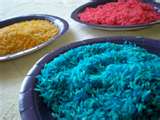
Making the Colored Rice: Measure the dry rice into a bowl. Add the rubbing alcohol or vinegar, and stir well to coat. Drop on the food coloring, stirring between each drop. Add food coloring, and keep mixing until the rice is your desired color. Place a sheet of waxed paper or foil on a flat surface. Pour the colored rice onto the waxed paper or aluminum foil. Allow the colored rice to dry completely. This usually takes about 30-60 minutes. Repeat steps to make additional colors of rice.

Making Art with the Colored Rice: To make a mosaic, have the child draw a simple a design onto a piece of cardstock or thin cardboard. Add glue to the design, one area at a time, and then sprinkle on the colored rice. Children with ASD might become over stimulated if given too much rice at once, so it is best to put the rice in small paper cups (bathroom size works well). Also, when applying the glue, give children a small amount with a paintbrush- this helps with the “over squeeze” we often see children engaging in when given the glue container. This activity can be a nice way to teach shapes and colors for younger children by filling simple outlines. For older children, more intricate designs can be incorporated.

Musical Shakers

By making a musical shaker, children can learn how the tactile elements create sound; allowing them to experiment and feel the items as they are used in fun ways.

Here are some things you can collect to make a variety of shakers: coffee cans, plastic yogurt containers, spice bottles, paper towel rolls. Inside materials: dried peas, popcorn, pennies, dried macaroni, dried beans, and other materials that child may be drawn to. (* this activity should be highly supervised with children who are very oral)

Steps for making shakers: Wash and dry all the empty containers. Have child pick out and choose one to decorate. They can use a variety of art materials to cover the container depending on their age and functioning level. Construction paper is usually a nice way to cover any lettering or labels that have not come off. Offer markers, crayons or glitter glue. Allow the container to dry before filling it.

Experiment with the dried materials by having child reach into the bowl and feel around. Ask child what they think adding that to a shaker would sound like? Let them do this with a few different textures.

When ready, fill each container between one half and two thirds full with the dried beans, macaroni, peas, popcorn seeds or rice. You can mix a couple of the dried ingredients together with some pennies to create different sounds. Attach the lids of the containers, making sure they are tightly sealed. Let them shake, shake, shake, and then you can turn on their favorite songs and let them play to the music.


Wednesday, January 7, 2009

Children and Creativity

Creativity in childhood is typically assessed through paper-and-pencil measures such as the Torrance Test of Creative Thinking. These tests are designed to measure divergent thinking, such as fluency, flexibility, originality, and elaboration. Signification criticisms have been raised about these tests as measures of creativity. First is the general problem that there are no universally accepted definitions of creativity. Second, critics of creativity tests argue that these tests do not measure creativity per se but instead reflect the specific abilities that are assessed by the tests. Third, the scores on these tests often depend partly on speed, which is not necessarily a criterion for creativity. A final consistent concern relates to the scoring of creativity tests, which by definition are somewhat subjective. Thus, the reliability of such tests is commonly questioned.

Infancy
From birth to 18 months, infants can be encouraged to engage in creativity by playing with a variety of safe household materials, such as margarine tubs, empty boxes, and large empty spools. Parents and caregivers can encourage experimentation by showing excitement and interest in what babies do.
Parents can encouraged infants to develop creativity by singing to the infant and playing music, moving the infant's hands to music, hanging a colorful mobile over the crib, placing pictures and photos where the baby can focus on them, and playing sound games with infants, such making up nonsense words or using rhyming words when talking to them.

Toddlerhood
From ages 18 months to four years, toddlers have progressively better hand and eye coordination. Caregivers should give them opportunities to develop this coordination by allowing them to draw with water-based paints, with chalk, and with crayons. Toddlers also can develop their creativity by pasting, tearing, cutting, printing, modeling with clay or play dough, or working with various materials to create collage, and for the older child, experimenting with fabric, tie dye, batik, printing, and simple woodwork. From around 12 months, children may begin to imitate things that adults do. Real fantasy play begins at around ages 18 to 21 months. This should not prevent caregivers from playing imaginatively from a younger age, since fantasy play is linked to creativity. Studies have shown that children with very active fantasies tend to have personality traits that contribute to creativity—originality, spontaneity, verbal fluency, and a higher degree of flexibility in adapting to new situations. Children who fantasize a lot have unusually good inner resources for amusing themselves. Parents can provide materials that lend themselves to fantasy play (dressing-up clothes, dolls, housecleaning sets, and stuffed animals), play pretending games with their children, and make suggestions and encourage new ideas when toddlers play alone. Adults should start involving toddlers with creative activities as soon as they feel the child will enjoy them. Adults need to remember that young toddlers are not skillful enough to consciously produce works of art. At 18 months they may be more ready for creative play and even at this age, they may spend no more than five minutes of concentration on any one activity.

Preschool
Preschoolers can use the same materials as toddlers but can use them in more complex ways. By age five, many children start drawing recognizable objects. By age six, they are usually interested in explaining their art works. They also like to tell stories and can make books of their stories, including drawing pictures to accompany the writing. At this age fantasy play becomes more complex. Preschoolers often direct each other on what to do or say as they play "Let's pretend." Play is a critical part of developing creativity, according to Mary Mindess, a child psychology professor at Lesley University in Cambridge, Massachusetts. "Play allows children to construct meaning for themselves," Mindess stated in an article in the August 2001 newsletter The Brown University Child and Adolescent Behavior Letter. "Two children may share an experience, but each will process the experience differently. Very often during play, children take things they see in real life, or things they imagine they experience—like something they read in a book or saw on television—and make meaning of it," she wrote.

School Age
Early school-age children, six to nine years, incorporate lots of fantasy into their play, including action games with superheroes. Children of this age group spend much of their time daydreaming. Some daydreams become "real" as children begin to act them out in stories and plays. Many researchers believe that in order to foster creativity in schools, education should be based on the discovery of knowledge and the development of critical attitudes, rather than on the passive absorption of knowledge. They believe this applies whether the class is in art, history, science, or humanities. However, most school teaching in the United States is based on the child's ability to memorize. The highest marks are often given to those who merely studied their lessons well. The pupil whose creative side is more developed may be considered a disruptive member of the class. At ages nine to 12, children's creativity is greatly affected by peer influence. They increase the amount of detail and use of symbols in drawings. They also have expanded their individual creative differences and begin to develop their own set of creative values.

Adolescents
Teenagers are highly critical of the products they make and ideas they have. They try to express themselves creatively in a more adult-like way. Their creativity is influenced by their individual differences, physically, mentally, emotionally, and socially. In most high schools, classes that stress creativity, such as art, music, writing, and drama are electives and many may not be required. For many adolescents, high school is their last opportunity to take these creative classes.
Also, teens become more self-aware and self-conscious. This focus often causes them to conform to their peers, which stifles their creativity and makes their thoughts less flexible. Flexibility refers to the ability to consider various alternatives at the same time.

Common Problems & Parental Concerns
Rewards or incentives appear to interfere with creativity and reduce children's flexibility of thought. Studies show that any constraints such as structured instructions reduce creative flexibility in children. Many parents and teachers do not understand that children who are creative are often involved in imaginary play and are motivated by internal rather than external factors. Environment appears to play a greater role than heredity in the development of creativity: identical twins reared apart show greater differences in creativity than in intellectual ability. Family environments with certain characteristics have been found to be more conducive to creativity than others. One of these characteristics is a relaxed parental attitude rather than one that is overly anxious or authoritarian. On the whole, the families of creative children discipline them without rigid restrictions, teaching them respect for values above rules. Similarly, they emphasize achievement rather than grades. The parents in such homes generally lead active, fulfilling lives themselves and have many interests. Finally, they reinforce creativity in their children by a general attitude of respect and confidence toward them and by actively encouraging creative pursuits and praising the results. It has been found that creativity in both children and adults is affected by positive reinforcement. Schools as well as families can encourage creativity by offering children activities that give them an active role in their own learning, allow them freedom to explore within a loosely structured framework, and encourage them to participate in creative activities for the sheer enjoyment of it rather than for external rewards. (http://www.answers.com/topic/creativity)

Sunday, November 2, 2008

Introduction


Colors of Play, LLC provides creative arts therapy programming and related services for children, adolescents and young adults with special needs; including physical and cognitive disabilities, autistic spectrum disorders, children coping with medical conditions, bereavement and hospitalization.
We specialize in providing comprehensive consulting, program design and development to agencies and organizations that serve these populations.
Services Include: • Creative Arts program development for non-profit organizations• Arts Enrichment programs for schools and social services agencies• Consulting services for healthcare facilities• Clinical Creative Art Therapy for children, adolescents, and young adults.
Pamela R. Ullmann, MS, ATR-BC, LCAT
Licensed Creative Art Therapist and Founder
For more information on Art Therapy, specific programs, and ways to include creative arts programming in the lives of many, please visit our website http://www.colorsofplay.com/
Pamela Ullmann can be contacted via email at Pamela@colorsofplay.com or by phone at 201-906-6555

Colors of Play, LLC Serving New Jersey and the New York Metropolitan Area
Copyright © Colors of Play, LLC. All rights reserved.