As I observed a young boy with Autism in one of our groups, I kept trying to “figure him out”. Why does he flutter his hands? What makes him jumpy or make the sounds that he does? How can we get him to participate with the others in the art therapy process? As clinicians, we are always looking for the right approach or mix or perhaps the right ”connection” to the child. But what I am discovering is that maybe those answers will not be avaialble any time soon- so in the meantime I think that focusing on the journey with the child and staying with the unanswered questions can be the enough for the moment. It may feel as if we are not connecting or making progress, but as with all therapeutic processes the subleties can pave the way.
Here are some points to keep in mind when working with children with Autism Spectrum Disorders:
1) Remember that Autism is a challenging disorder and there will be a lot of tough days, so go easy on yourself.
2) Meet the child where they are at that moment in time. Sense the energy level and try to empathize with their potential discomforts. If the energy is high and overstimulating, offer calming activities with little pressure.
3) If the child’s voice or level of verbal sounds is loud….do not try to “speak over them” but rather lower your voice and calmly wait for them to see that you are trying to communicate with them, this takes patience. But, very often they will want to hear you and will become quieter in order to listen.
4) Sometimse offering a light touch or contact to their should or back may get their attention, calm them or regulate their energy. But be careful to ask the child if it is ok to touch them as it can be misread and there may be issues with touch.
5) Be aware of bright lights, loud outside noises or other stimulating sources in the environment. See if dimming lights helps, or adding soft music to the room helps. You can also teach the child to do deep breathing….this sometimes works wonders, espsecially if you make it into a game or use bubbles.
So, although we may not have all the answers to everything about how and why the child behaves a certain way or can’t seem to connect to his peers or to us, we can relax a bit and just try to be available for the child as best we can. As we travel the journey, an answer or two may just appear when its supposed to.
Showing posts with label art therapy. Show all posts
Showing posts with label art therapy. Show all posts
Thursday, December 29, 2011


Monday, March 14, 2011
Create Flash Cards to help Children with Autism Learn about Feelings
Children with Autism very often cannot fully comprehend feelings. They generally do not
understand how to read facial expressions on others and how these expressions
can indicate emotions. As a result, they have problems learning how to express
their own feelings and then can become frustrated. This frustration can turn
into meltdowns because they have difficulties communicating those feelings and
then frustration grows out of control. One of the best ways to teach children
with Autism to communicate feelings is to use or create visual aids so that they can begin to recognize these more fully.

Making flashcards together can be an effective way for children to relate and
recognize feelings. Gather magazines,stickers, scissors, index cards and glue to create your own flashcards. You can use pictures of favorite characters and actors and then cut out each one and paste it onto the card. You can also use stickers of different characters. Then
go through the flashcards with the child asking him how he feels about the
different pictures. See the nonverbal reactions as well. You can write the
correct emotion or feeling on the back and let him know what that emotion is.
Or you can write it on the front to encourage the verbal.
During your sessions,when emotions arise, ask the child for the appropriate card that corresponds to the feeling. Or model for him, for example when he gets angry, tell him that it
seems that he is angry and show him the right card. Do this for each card until
he starts to understand. Then you can praise or reward him for getting the
right card.
Use the words “I feel”along with the card, as in “I feel…” and then show the appropriate card. Or ifthe child is showing a particular emotion, say “I feel…” and show that card. Encourage the child to say the same phrase and show you the card. He doesn't have to verbally express the emotion yet, but try to have the child show you the emotion card
and if verbal, eventually say the phrase.
and if verbal, eventually say the phrase.
Continue to teach the child to say the emotion with the phrase. The goal would be that after sometime, he will be able to show you the appropriate card along with saying how he
feels. However, if verbal skills are limited, at least the cards will help him
communicate these feelings. You can use the cards less as the child is able to
express the emotions in other ways, but generally the visual aids can be useful
to keep on hand during all therapeutic activities.
Sunday, January 9, 2011
"Art As Therapy": Sensory Activities for the Child with Autism
Very often my goals as an art therapist will focus on the creative expression in developing the child’s imagination, communication and socialization skills. These are all areas that the child with Autism Spectrum Disorder is working on in school, home and other therapies as well. However, sometimes art can simple be used in a more non-directed way and purely allow the child to experience the sensory elements of the materials.
In the field of Art Therapy, using the model of “Art as Therapy” is a process that allows individuals to experience the art making with little direction. This then allows them to gain insight and open up to their feelings in their own time. However, with the population of Autism, I see the “Art as Therapy” model more about the intrinsic sensory processes and believe that it can benefit the child that needs to “just have fun” with the creative activities. Having fun and engaging in this experience can then ultimately regulate the senses, emotions and behaviors.
Let’s explore some techniques and materials that both professionals and parents can use to help their children have this experience. These are some activities that can be adapted for any functioning level by either limiting the amount of materials presented and/or limiting the time allotted
 Cornstarch Goo
This activity can be a little messy, but often will be a fun way to build a tolerance to wet materials. It is more a “play” activity rather than an art making one, because there is no product at the end. Sometimes the simplest of ingredients can create a great tactile experience- cornstarch and water is a great example of that. Combining these two ingredients makes a fun “goo” that acts like a solid and a liquid at the same time. It’s a great learning activity that will fascinate the kids about how things work.
Making the goo: In a medium size bowl, start with 1 cup of cornstarch and add the water one tablespoon at a time. Stir carefully and add a bit more water or cornstarch as needed to get the right consistency. You’ll know the right consistency when you see it — you won’t quite be able to stir it, but it will still look liquid.
The mixture will act like a solid when you squeeze it or press on it, but when you let it relax; it turns into liquid-like goo. Have the child scrape some up out of the bowl and squeeze it in their hand and watch the material form shapes. Then tell them to relax their hand and watch the shape melt between their fingers and drip back into the bowl. Make a game out of it by seeing how long the shape can stay solid before dripping back to liquid.
 Colored Rice Mosaics
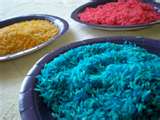
This is a project that can be both tactile as well as creative. The senses are engaged, while the goal will be to produce a work of colorful art. The preparation should be done before presenting to the child.
Ingredients: 1 cup dry white rice, 1 teaspoon rubbing alcohol or white vinegar, 3 to 4 drops food coloring, medium size bowl and spoon, and waxed paper or aluminum foil.
Making the Colored Rice: Measure the dry rice into a bowl. Add the rubbing alcohol or vinegar, and stir well to coat. Drop on the food coloring, stirring between each drop. Add food coloring, and keep mixing until the rice is your desired color. Place a sheet of waxed paper or foil on a flat surface. Pour the colored rice onto the waxed paper or aluminum foil. Allow the colored rice to dry completely. This usually takes about 30-60 minutes. Repeat steps to make additional colors of rice.
Making Art with the Colored Rice: To make a mosaic, have the child draw a simple a design onto a piece of cardstock or thin cardboard. Add glue to the design, one area at a time, and then sprinkle on the colored rice. Children with ASD might become over stimulated if given too much rice at once, so it is best to put the rice in small paper cups (bathroom size works well). Also, when applying the glue, give children a small amount with a paintbrush- this helps with the “over squeeze” we often see children engaging in when given the glue container. This activity can be a nice way to teach shapes and colors for younger children by filling simple outlines. For older children, more intricate designs can be incorporated.
 Musical Shakers
By making a musical shaker, children can learn how the tactile elements create sound; allowing them to experiment and feel the items as they are used in fun ways.
Here are some things you can collect to make a variety of shakers: coffee cans, plastic yogurt containers, spice bottles, paper towel rolls. Inside materials: dried peas, popcorn, pennies, dried macaroni, dried beans, and other materials that child may be drawn to. (* this activity should be highly supervised with children who are very oral)
Steps for making shakers: Wash and dry all the empty containers. Have child pick out and choose one to decorate. They can use a variety of art materials to cover the container depending on their age and functioning level. Construction paper is usually a nice way to cover any lettering or labels that have not come off. Offer markers, crayons or glitter glue. Allow the container to dry before filling it.
Experiment with the dried materials by having child reach into the bowl and feel around. Ask child what they think adding that to a shaker would sound like? Let them do this with a few different textures.
When ready, fill each container between one half and two thirds full with the dried beans, macaroni, peas, popcorn seeds or rice. You can mix a couple of the dried ingredients together with some pennies to create different sounds. Attach the lids of the containers, making sure they are tightly sealed. Let them shake, shake, shake, and then you can turn on their favorite songs and let them play to the music.
In the field of Art Therapy, using the model of “Art as Therapy” is a process that allows individuals to experience the art making with little direction. This then allows them to gain insight and open up to their feelings in their own time. However, with the population of Autism, I see the “Art as Therapy” model more about the intrinsic sensory processes and believe that it can benefit the child that needs to “just have fun” with the creative activities. Having fun and engaging in this experience can then ultimately regulate the senses, emotions and behaviors.
Let’s explore some techniques and materials that both professionals and parents can use to help their children have this experience. These are some activities that can be adapted for any functioning level by either limiting the amount of materials presented and/or limiting the time allotted

This activity can be a little messy, but often will be a fun way to build a tolerance to wet materials. It is more a “play” activity rather than an art making one, because there is no product at the end. Sometimes the simplest of ingredients can create a great tactile experience- cornstarch and water is a great example of that. Combining these two ingredients makes a fun “goo” that acts like a solid and a liquid at the same time. It’s a great learning activity that will fascinate the kids about how things work.
Making the goo: In a medium size bowl, start with 1 cup of cornstarch and add the water one tablespoon at a time. Stir carefully and add a bit more water or cornstarch as needed to get the right consistency. You’ll know the right consistency when you see it — you won’t quite be able to stir it, but it will still look liquid.
The mixture will act like a solid when you squeeze it or press on it, but when you let it relax; it turns into liquid-like goo. Have the child scrape some up out of the bowl and squeeze it in their hand and watch the material form shapes. Then tell them to relax their hand and watch the shape melt between their fingers and drip back into the bowl. Make a game out of it by seeing how long the shape can stay solid before dripping back to liquid.
This is a project that can be both tactile as well as creative. The senses are engaged, while the goal will be to produce a work of colorful art. The preparation should be done before presenting to the child.
Ingredients: 1 cup dry white rice, 1 teaspoon rubbing alcohol or white vinegar, 3 to 4 drops food coloring, medium size bowl and spoon, and waxed paper or aluminum foil.
Making the Colored Rice: Measure the dry rice into a bowl. Add the rubbing alcohol or vinegar, and stir well to coat. Drop on the food coloring, stirring between each drop. Add food coloring, and keep mixing until the rice is your desired color. Place a sheet of waxed paper or foil on a flat surface. Pour the colored rice onto the waxed paper or aluminum foil. Allow the colored rice to dry completely. This usually takes about 30-60 minutes. Repeat steps to make additional colors of rice.
Making Art with the Colored Rice: To make a mosaic, have the child draw a simple a design onto a piece of cardstock or thin cardboard. Add glue to the design, one area at a time, and then sprinkle on the colored rice. Children with ASD might become over stimulated if given too much rice at once, so it is best to put the rice in small paper cups (bathroom size works well). Also, when applying the glue, give children a small amount with a paintbrush- this helps with the “over squeeze” we often see children engaging in when given the glue container. This activity can be a nice way to teach shapes and colors for younger children by filling simple outlines. For older children, more intricate designs can be incorporated.

By making a musical shaker, children can learn how the tactile elements create sound; allowing them to experiment and feel the items as they are used in fun ways.
Here are some things you can collect to make a variety of shakers: coffee cans, plastic yogurt containers, spice bottles, paper towel rolls. Inside materials: dried peas, popcorn, pennies, dried macaroni, dried beans, and other materials that child may be drawn to. (* this activity should be highly supervised with children who are very oral)
Steps for making shakers: Wash and dry all the empty containers. Have child pick out and choose one to decorate. They can use a variety of art materials to cover the container depending on their age and functioning level. Construction paper is usually a nice way to cover any lettering or labels that have not come off. Offer markers, crayons or glitter glue. Allow the container to dry before filling it.
Experiment with the dried materials by having child reach into the bowl and feel around. Ask child what they think adding that to a shaker would sound like? Let them do this with a few different textures.
When ready, fill each container between one half and two thirds full with the dried beans, macaroni, peas, popcorn seeds or rice. You can mix a couple of the dried ingredients together with some pennies to create different sounds. Attach the lids of the containers, making sure they are tightly sealed. Let them shake, shake, shake, and then you can turn on their favorite songs and let them play to the music.
Tuesday, October 26, 2010
Before the Meltdown: Sensory, Emotional and Behavioral Interplay
Most children who are diagnosed on the autism spectrum have difficulty regulating their emotions and maintaining a calm state as we know. Children with autism and special needs go through similar emotional challenges as typical children do, but it takes them longer to get through them and it may take some creative techniques. In addition, it is sometimes difficult to recognize which emotions may be prominent in the child with ASD because sensory needs may look like an emotional or behavioral reaction.
Parents, teachers and therapists can help by recognizing the emotions and offering empathy when behaviors escalate. De-escalation is the key. By learning about the child’s sensory issues, and behavioral triggers we can begin to recognize the signs before hand; and thereby help the child regulate and avoid an emotional meltdown.
If and when emotions become overwhelming to the child, try to acknowledge those feelings and not stop them from being expressed. Tell the child that when he cries it is caused by a feeling and that it will pass like a dark cloud. The sun will come out again, even though it feels like the sky is falling. Help him learn to take a few slow deep breaths when he first begins to feel upset.
In our creative arts therapy groups or in any other social skills or therapeutic groups, we can address these issues both in neutral times, when there is no upset as well as when a child in the group starts have difficulties. We can praise the children when we see them regulating themselves and we can offer mirroring for when we notice that negative behaviors are escalating.
Example
A child may start banging the table and fidgeting, so we need to recognize this behavior whether out of frustration or another sensory need and take it as a “sign”. We may reflect back to the child either verbally, “I see you are banging the table Johnny, sometimes it is hard to stay in our seats…. And you are doing so well…..” Or perhaps, non-verbally bang along with the child and create a playful interchange. (I have offered clay or model magic and that seems to work wonders for frustration control) However, that banging on the table could have in fact been a sensory need to move, or hear sound, or just feel the table against his hands. We may not always get it right, but we are still recognizing the need. In any case, as we get to know the children in our classes or groups we can distinguish their needs, emotions and behaviors.
Taking breaks and using sensory toys and art materials may help a child regulate when frustration levels seem overwhelming within the group. When a child needs that break, have an aide work with them for a set amount of time a little bit away from the group; not leaving the room entirely unless necessary. Then allow that child to slowly rejoin the activity when ready and then praise them for their efforts.
Parents, teachers and therapists can help by recognizing the emotions and offering empathy when behaviors escalate. De-escalation is the key. By learning about the child’s sensory issues, and behavioral triggers we can begin to recognize the signs before hand; and thereby help the child regulate and avoid an emotional meltdown.
If and when emotions become overwhelming to the child, try to acknowledge those feelings and not stop them from being expressed. Tell the child that when he cries it is caused by a feeling and that it will pass like a dark cloud. The sun will come out again, even though it feels like the sky is falling. Help him learn to take a few slow deep breaths when he first begins to feel upset.
In our creative arts therapy groups or in any other social skills or therapeutic groups, we can address these issues both in neutral times, when there is no upset as well as when a child in the group starts have difficulties. We can praise the children when we see them regulating themselves and we can offer mirroring for when we notice that negative behaviors are escalating.
Example
A child may start banging the table and fidgeting, so we need to recognize this behavior whether out of frustration or another sensory need and take it as a “sign”. We may reflect back to the child either verbally, “I see you are banging the table Johnny, sometimes it is hard to stay in our seats…. And you are doing so well…..” Or perhaps, non-verbally bang along with the child and create a playful interchange. (I have offered clay or model magic and that seems to work wonders for frustration control) However, that banging on the table could have in fact been a sensory need to move, or hear sound, or just feel the table against his hands. We may not always get it right, but we are still recognizing the need. In any case, as we get to know the children in our classes or groups we can distinguish their needs, emotions and behaviors.
Taking breaks and using sensory toys and art materials may help a child regulate when frustration levels seem overwhelming within the group. When a child needs that break, have an aide work with them for a set amount of time a little bit away from the group; not leaving the room entirely unless necessary. Then allow that child to slowly rejoin the activity when ready and then praise them for their efforts.
Thursday, August 19, 2010
“Hands-on” Learning for ASD Through Visual and Creative Modalities
Many children with autism tend to be visual learners and traditional methods of instruction can often be quite challenging. For example, while the average child learns language through social interactions by mimicking the words they hear in everyday conversations, children with autism spectrum disorder may not absorb speech and language skills as readily. Often, children with autism do not imitate others in the same way that average children do, making it necessary to take a more direct approach. Signed speech, which uses sign language in conjunction with spoken language to visually reinforce new words and concepts, is a hands-on approach to teaching speech and language skills.
Hands on projects use that same principle of multisensory learning, combining visual, tactile, and verbal stimuli to teach new skills and concepts, appealing to the learning characteristics of many autistic children. Hands on projects can be integrated into nearly any learning experience. For example, you can tell a story while working together to illustrate it with simple drawings that can aid in comprehension, while keeping children engaged in social interaction. Paper cutouts, used to act out a story as it is read can be great literacy and comprehension reinforcement, and having the child participant in creating them offers another hands-on activity.
• Drawing and coloring flashcards can help in the development of fine motor skills while teaching letter and number recognition, or decorating them with fabrics and objects of varying textures can add tactile elements to the lesson.
• Mixing instant puddings or homemade play dough can help children learn to follow simple instructions with the help of tactile stimulation to maintain attention.
• Older children can benefit from cooking or baking projects, learning math skills through measuring ingredients and gaining competency in following directions. Also, getting to eat the finished product is a tangible reward for a job well done.
• Art projects that correspond with lesson plans for the day can be very helpful in reinforcing academic subjects, such as making clay models of animals or objects learned about earlier in the day.
• Model building, painting, or drawing projects can bring history or social studies lessons firmly into focus for autistic children, and lessons on plant biology can be brought home with a plant growing project.
Short attention spans are common in children with autism, another issue that is often eased with the use of hands on projects for autistic students. Active learning can be a great help in keeping children focused, alert, and engaged, making it easier to stay on task. If attention span becomes an issue when hands on projects are underway, divide each project into small steps with breaks given after each one. Lengthening those intervals between breaks gradually can help the child slowly build a more appropriate attention span.
Hands on projects are a great way to teach children on the spectrum. In fact, all child can benefit from the combination of activity and education that these modalities offer. In an integrated learning environment, hands on projects can help children with autism interact and cooperate with other children, promoting understanding and fostering those vital social and communication skills. And of course hands on projects are much more fun for all involved.
Hands on projects use that same principle of multisensory learning, combining visual, tactile, and verbal stimuli to teach new skills and concepts, appealing to the learning characteristics of many autistic children. Hands on projects can be integrated into nearly any learning experience. For example, you can tell a story while working together to illustrate it with simple drawings that can aid in comprehension, while keeping children engaged in social interaction. Paper cutouts, used to act out a story as it is read can be great literacy and comprehension reinforcement, and having the child participant in creating them offers another hands-on activity.
• Drawing and coloring flashcards can help in the development of fine motor skills while teaching letter and number recognition, or decorating them with fabrics and objects of varying textures can add tactile elements to the lesson.
• Mixing instant puddings or homemade play dough can help children learn to follow simple instructions with the help of tactile stimulation to maintain attention.
• Older children can benefit from cooking or baking projects, learning math skills through measuring ingredients and gaining competency in following directions. Also, getting to eat the finished product is a tangible reward for a job well done.
• Art projects that correspond with lesson plans for the day can be very helpful in reinforcing academic subjects, such as making clay models of animals or objects learned about earlier in the day.
• Model building, painting, or drawing projects can bring history or social studies lessons firmly into focus for autistic children, and lessons on plant biology can be brought home with a plant growing project.
Short attention spans are common in children with autism, another issue that is often eased with the use of hands on projects for autistic students. Active learning can be a great help in keeping children focused, alert, and engaged, making it easier to stay on task. If attention span becomes an issue when hands on projects are underway, divide each project into small steps with breaks given after each one. Lengthening those intervals between breaks gradually can help the child slowly build a more appropriate attention span.
Hands on projects are a great way to teach children on the spectrum. In fact, all child can benefit from the combination of activity and education that these modalities offer. In an integrated learning environment, hands on projects can help children with autism interact and cooperate with other children, promoting understanding and fostering those vital social and communication skills. And of course hands on projects are much more fun for all involved.
Tuesday, July 20, 2010
Art Makes Sense- Sensory Art Therapy

Creative art making can offer unique ways for children to gain a sense of control and mastery of their environment, grow in self expression, self awareness and self-esteem. This holds true for children with special needs, ASD (Autism Spectrum Disorder), and other developmental issues as well. However, these children very often have “sensory” issues or sensory integration disorder which can affect their responses to various art materials.
That is why it is important to have a trained and credentialed art therapist or related professional assess the child and create a customized program that can help the child with sensory issues while at the same time engage in creative expression.
Children may experience deficits in one or several sensory areas; the most often observed is visual processing, auditory processing, and “tactile defensiveness” (an aversion to certain textures and touching). Art making with an experienced therapist can often break through these issues in a fun and non-threatening way; enabling the child to experience new and creative expression.
Visual Techniques:
Art making is obviously a visual modality, but those children with visual processing issues may need adaptations, concrete steps, and prompts in order to follow effectively. Sometimes using a page border helps contain the image making. Using dark colors on white paper or white chalk on black paper can create maximum contrast. Utilizing thicker crayons and markers can build a stronger visual focus. Also, the therapist can incorporate dotted lines as a “starter” for the child to trace around lines or shapes. Another processing technique is to present materials in a clock-like manner one by one; avoiding too many materials in the working space.
Art making is obviously a visual modality, but those children with visual processing issues may need adaptations, concrete steps, and prompts in order to follow effectively. Sometimes using a page border helps contain the image making. Using dark colors on white paper or white chalk on black paper can create maximum contrast. Utilizing thicker crayons and markers can build a stronger visual focus. Also, the therapist can incorporate dotted lines as a “starter” for the child to trace around lines or shapes. Another processing technique is to present materials in a clock-like manner one by one; avoiding too many materials in the working space.
Helpful Techniques for Auditory Processing Difficulties
• Combine verbal instructions with sign language or hand motions
• Make sure the art making activity is presented in a quiet room or area
• Utilize pictures or “samples” of a particular art project when giving directions
• Use visual cues when transitioning from one activity to another along with instructions (such as flashing lights on and off in the room)
What is Tactile Defensiveness?
The main cause is neurological disorganization in the midbrain region of the brain which is basically responsible for filtering incoming stimuli, and, may not sufficiently screen out all extraneous tactile stimulation causing the child to perceive the input as extreme and uncomfortable. The central nervous system ability to process tactile sensory input is distorted causing the child great discomfort. Their brain may register subtle sensations as extreme irritation or even painful and he may respond in an abnormally reactive way such as grimacing or pulling away from the stimulus.
The main cause is neurological disorganization in the midbrain region of the brain which is basically responsible for filtering incoming stimuli, and, may not sufficiently screen out all extraneous tactile stimulation causing the child to perceive the input as extreme and uncomfortable. The central nervous system ability to process tactile sensory input is distorted causing the child great discomfort. Their brain may register subtle sensations as extreme irritation or even painful and he may respond in an abnormally reactive way such as grimacing or pulling away from the stimulus.
Sensory based art making is a fascinating modality that allows children to engage in creative expression with no pressures. Using this approach, an Art Therapist can assess the severity of tactile issues and can help the child build tolerance in this area. Depending on the nature of the tactile defensiveness, the art therapist can use materials within the art making or as a separate activity of just playing with the materials; this starts the process of de-sensitizing the child in a fun and non-threatening manner.
Here are some art and play materials that are often used:
• Cornstarch and water play (creates a “gooey-like substance)
• Feathers, chenille, pom-poms to create “texture collages”
• Water-play using food dye and various containers
• Play dough, putty, and other modeling compounds
• String, felt, other craft materials
• Sand –art
• Shaving cream finger-painting
• Rice, shredded tissue paper
• Cornstarch and water play (creates a “gooey-like substance)
• Feathers, chenille, pom-poms to create “texture collages”
• Water-play using food dye and various containers
• Play dough, putty, and other modeling compounds
• String, felt, other craft materials
• Sand –art
• Shaving cream finger-painting
• Rice, shredded tissue paper
The list goes on and the therapist can create recipes and projects that are tailored to the child’s interests to encourage engagement. The caution here would be to go slowly and not overwhelm or over stimulate the child with an abundance of tactile materials. Let the child take the lead and if the child responds negatively, make a note and try new materials.

Art Makes Sense-Sensory Art Therapy by Pamela Ullmann is licensed under a Creative Commons Attribution-NonCommercial-ShareAlike 3.0 Unported License.
Thursday, July 15, 2010
Painting with wheels!!

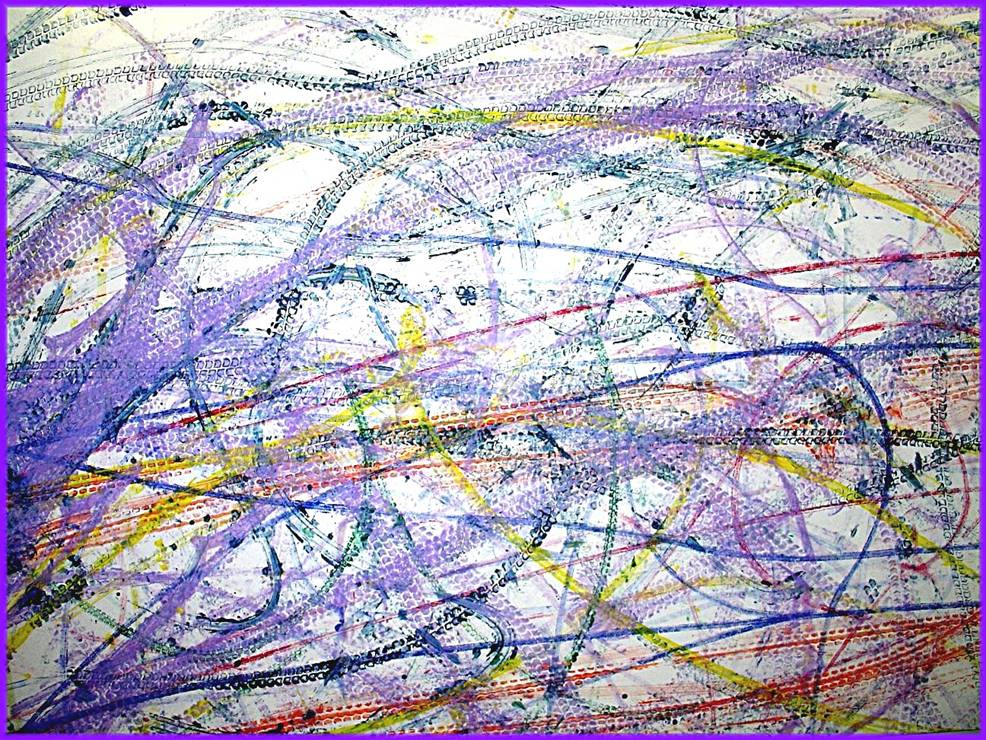
Although it has been a while since I have ran a "Wheel Art" workshop, I did find it very gratifying to help children create works of art with their own wheels!
What is Wheel Art?
Wheel Art is a unique activity for individuals who are wheel chair dependent. Each “wheel artist” uses the wheels of their chair to paint onto a large canvas secured to the floor. The artists all contribute their own style, color and unique patterns that create an amazing community mural to be shared.
Who Can Participate in Wheel Art?
The wheel artist may wheel themselves; either manually or through a powered wheel chair. Or, if they are not able to do so an assistant can help them move across the surface. Children, young adults and older adults all enjoy wheel art. Wheel art is empowering for the person confined to a wheel chair because it allows them to express their creativity in an exceptional way. Just as each person is unique, the patterns from their wheels are as well; they reflect a part of themselves which is “one of a kind”. After the piece is completed the artists can proudly look back and recognize their own tread marks on the canvas; feeling a part of a community of special individuals.
Painting with Wheels
Different painting techniques are used to achieve successful application onto the wheels. Non-toxic acrylic paints along with various brushes and rollers are used in conjunction with special additives to maximize paint vibrancy and fluidity.
Each wheel artist chooses a color to paint with. After successfully loading the wheels with their chosen color, the artist moves their chair through and across the surface of the canvas creating patterns and linear shapes throughout. Sometimes, a favorite song is played in the background while the painting takes place. The experience then becomes a “dance” with their chairs as well as a visual art activity. A wonderful process with a beautiful product!
For more information on having a "Wheel Art Day" for artists in wheel chairs, please email Pamela@colorsofplay.com
Tuesday, July 13, 2010
Autism and Creative Arts Therapy
An Emerging Need
Data released by the Centers for Disease Control (CDC) in 2007 revealed a startlingly high prevalence of Autism Spectrum Disorders in New Jersey children: 10.6 per 1,000, or one child in every 94.
School systems, health care facilities, and community service agencies struggle to meet a rising need and demand for innovative services that can give children on the autism spectrum the best chance to develop intellectually and socially, to discover their talents and cope with their challenges. Parents and siblings of children on the autism spectrum also need supportive services to cope with the stress of their children’s special needs.
We aim to develop a comprehensive creative arts therapy curriculum for children diagnosed with Autism Spectrum Disorders, including Art Therapy, Music Therapy and Dance Therapy. In addition, we will offer creative workshops and healing groups for overstressed family members.
Creative Arts Therapies for Children with Autism Spectrum Disorders
Creative arts therapies offer many benefits for children on the autism spectrum:
• Engaging hard-to-reach youth: Simply put, creative arts therapies are fun. Even children who resist other interventions may participate eagerly in Art, Music, and Dance Therapy
• Sensory Stimulation and Integration: Because children on the autism spectrum have heightened sensory needs, they often respond well to the multisensory stimulation and concrete, hands-on approach inherent in art, music, and dance therapy. Music and dance help to integrate the body and increase sensory tolerance.
• Socialization: Sharing art and performing together can help children on the autism spectrum build social skills and bond with peers.
• Communication and Self-Expression: Creative arts provide a precious medium of self-expression for children with limited or no verbal communication.
• Building the Imagination: Creative art therapies have unparalleled capacity to address imagination deficit, a classic characteristic of autism. Art therapy can help children with autism to build abstract thinking skills, creativity, and flexibility.
• Strengthening Family Relationships: Art therapy can also help families discover new ways of relating to children with autism spectrum disorders, and foster an appreciation of these children’s unique gifts. Workshops and healing groups targeted to parents and siblings of autistic children will help family members develop supportive peer relationships and coping skills.
Data released by the Centers for Disease Control (CDC) in 2007 revealed a startlingly high prevalence of Autism Spectrum Disorders in New Jersey children: 10.6 per 1,000, or one child in every 94.
School systems, health care facilities, and community service agencies struggle to meet a rising need and demand for innovative services that can give children on the autism spectrum the best chance to develop intellectually and socially, to discover their talents and cope with their challenges. Parents and siblings of children on the autism spectrum also need supportive services to cope with the stress of their children’s special needs.
We aim to develop a comprehensive creative arts therapy curriculum for children diagnosed with Autism Spectrum Disorders, including Art Therapy, Music Therapy and Dance Therapy. In addition, we will offer creative workshops and healing groups for overstressed family members.
Creative Arts Therapies for Children with Autism Spectrum Disorders
Creative arts therapies offer many benefits for children on the autism spectrum:
• Engaging hard-to-reach youth: Simply put, creative arts therapies are fun. Even children who resist other interventions may participate eagerly in Art, Music, and Dance Therapy
• Sensory Stimulation and Integration: Because children on the autism spectrum have heightened sensory needs, they often respond well to the multisensory stimulation and concrete, hands-on approach inherent in art, music, and dance therapy. Music and dance help to integrate the body and increase sensory tolerance.
• Socialization: Sharing art and performing together can help children on the autism spectrum build social skills and bond with peers.
• Communication and Self-Expression: Creative arts provide a precious medium of self-expression for children with limited or no verbal communication.
• Building the Imagination: Creative art therapies have unparalleled capacity to address imagination deficit, a classic characteristic of autism. Art therapy can help children with autism to build abstract thinking skills, creativity, and flexibility.
• Strengthening Family Relationships: Art therapy can also help families discover new ways of relating to children with autism spectrum disorders, and foster an appreciation of these children’s unique gifts. Workshops and healing groups targeted to parents and siblings of autistic children will help family members develop supportive peer relationships and coping skills.
Sunday, November 2, 2008
Introduction

Colors of Play, LLC provides creative arts therapy programming and related services for children, adolescents and young adults with special needs; including physical and cognitive disabilities, autistic spectrum disorders, children coping with medical conditions, bereavement and hospitalization.
We specialize in providing comprehensive consulting, program design and development to agencies and organizations that serve these populations.
Services Include: • Creative Arts program development for non-profit organizations• Arts Enrichment programs for schools and social services agencies• Consulting services for healthcare facilities• Clinical Creative Art Therapy for children, adolescents, and young adults.
Pamela R. Ullmann, MS, ATR-BC, LCAT
Licensed Creative Art Therapist and Founder
For more information on Art Therapy, specific programs, and ways to include creative arts programming in the lives of many, please visit our website http://www.colorsofplay.com/
Pamela Ullmann can be contacted via email at Pamela@colorsofplay.com or by phone at 201-906-6555
Colors of Play, LLC Serving New Jersey and the New York Metropolitan Area
Copyright © Colors of Play, LLC. All rights reserved.
We specialize in providing comprehensive consulting, program design and development to agencies and organizations that serve these populations.
Services Include: • Creative Arts program development for non-profit organizations• Arts Enrichment programs for schools and social services agencies• Consulting services for healthcare facilities• Clinical Creative Art Therapy for children, adolescents, and young adults.
Pamela R. Ullmann, MS, ATR-BC, LCAT
Licensed Creative Art Therapist and Founder
For more information on Art Therapy, specific programs, and ways to include creative arts programming in the lives of many, please visit our website http://www.colorsofplay.com/
Pamela Ullmann can be contacted via email at Pamela@colorsofplay.com or by phone at 201-906-6555
Colors of Play, LLC Serving New Jersey and the New York Metropolitan Area
Copyright © Colors of Play, LLC. All rights reserved.
Subscribe to:
Posts (Atom)